

Walk into most factories and you will find oil-lubricated screw compressors doing the heavy lifting: robust, familiar, and cost-effective. Then someone mentions a paint line, a pharmaceutical process, or an electronics assembly step, and the requirement changes to oil-free air. This guide explains what actually separates the two families, where each one earns its place, and how to decide — without mythology, using the ranges SIND actually publishes.
What “oil-free” and “oil-lubricated” actually mean
Both types are rotary screw compressors: two meshing rotors squeeze incoming air to a higher pressure. The difference is what happens inside the compression chamber.
- Oil-lubricated compressors inject oil into the compression chamber. The oil seals the clearances between rotors, absorbs compression heat, and lubricates the bearings. Part of that oil travels with the air and is removed again downstream by separators and filters — but “removed” is never the same as “never added”.
- Oil-free compressors keep oil outside the compression chamber entirely. The rotors run in their own gear-driven, oil-separated environment, so no oil is injected into the air stream at any point. What the process receives is air that never touched lubricant during compression.
One practical consequence matters for budgeting: oil-free machines carry a higher purchase price, while oil-lubricated machines shift part of the air-quality job to downstream equipment — filters, separators, and the discipline of maintaining them.
How an oil-lubricated screw compressor works
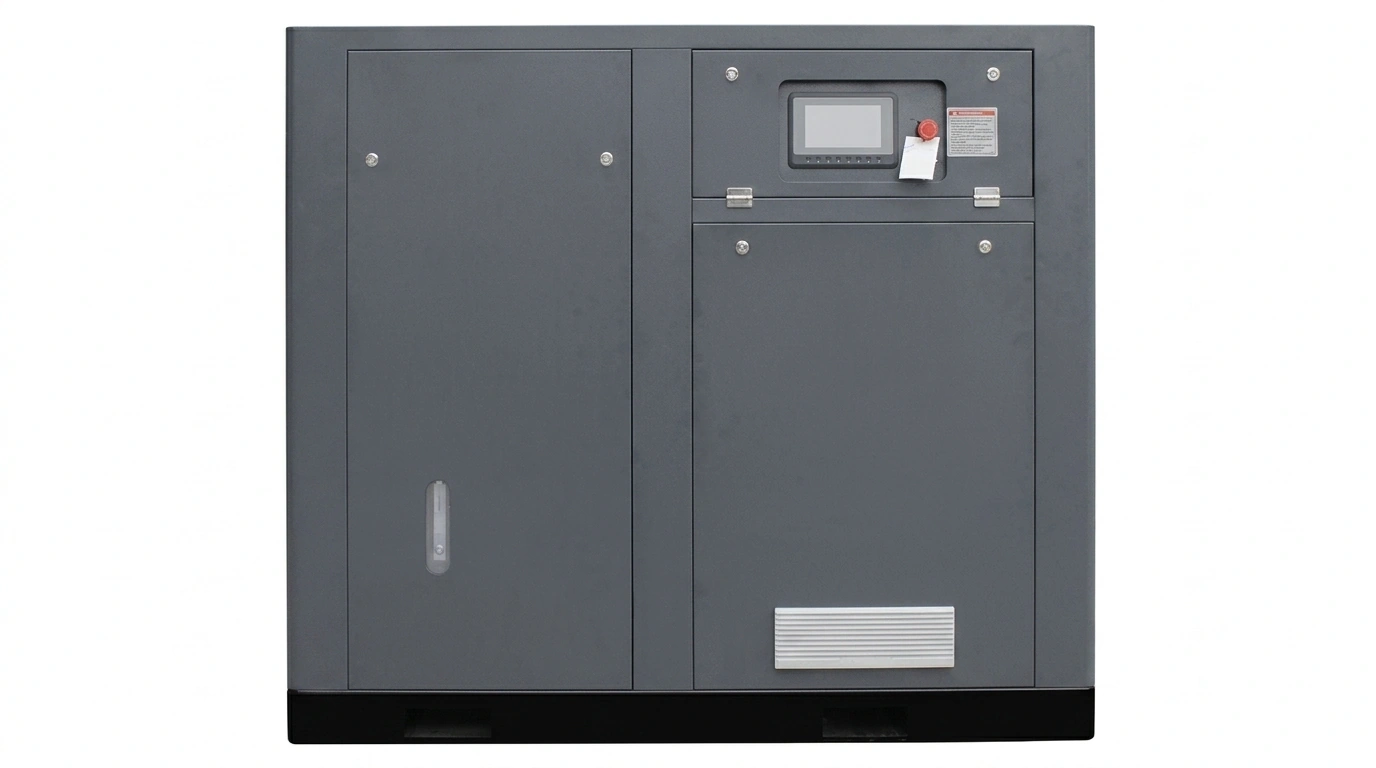
In an oil-lubricated screw compressor, oil is injected into the rotor chamber as the rotors turn. It performs three jobs at once: sealing the tiny clearances between the rotors (which is where a big share of the efficiency comes from), cooling the heat of compression, and lubricating the moving parts. The compressed air-oil mixture leaves the chamber, and the bulk of the oil is removed in a separator; fine filters polish the remainder. The air that reaches your plant is clean by industrial standards — and the amount of residual oil carryover depends on separator and filter condition, which is why filter maintenance directly protects product quality.
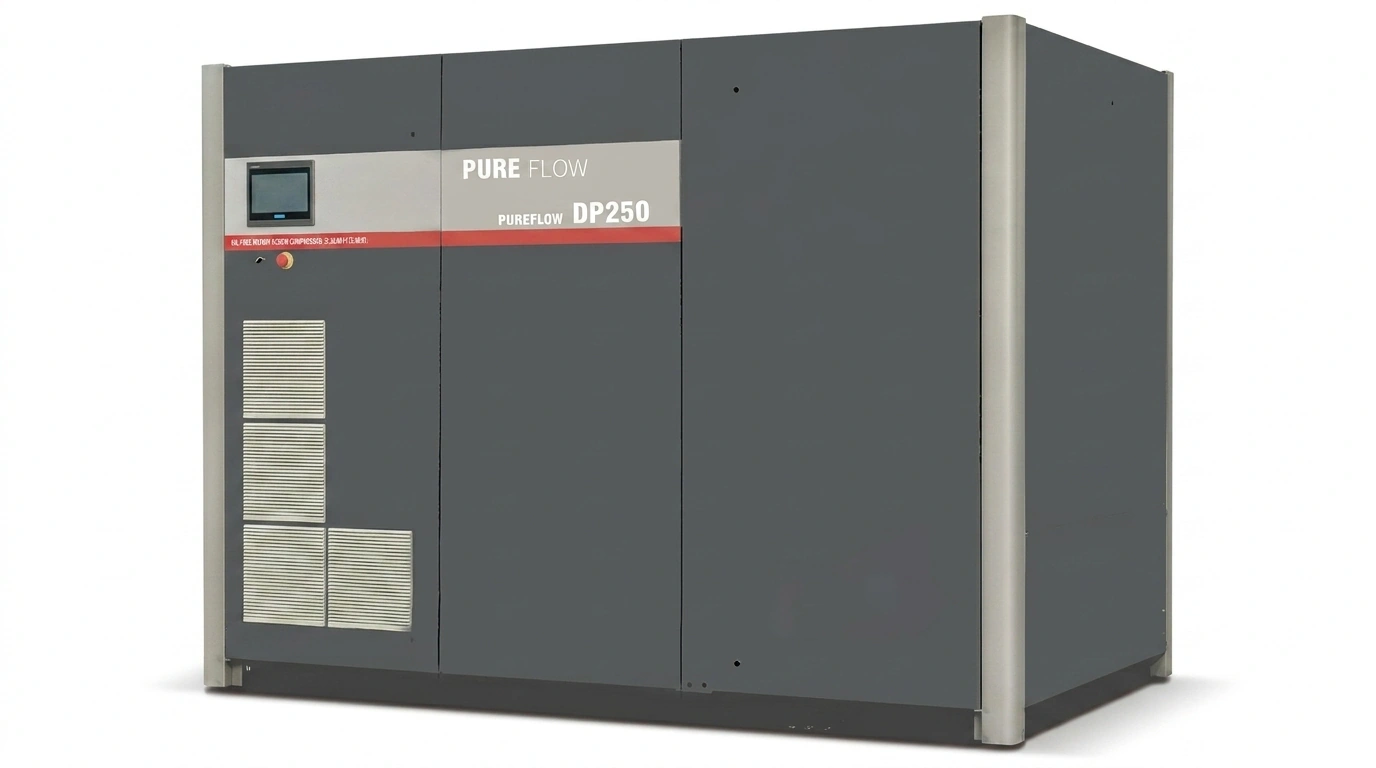
How an oil-free screw compressor works
In an oil-free screw compressor, the rotors do not touch oil. Timing gears keep the rotor profiles synchronized without contact, and the bearings live outside the compression chamber behind seals. Because no oil is injected, the machine cannot rely on oil for sealing and cooling, so the rotor profiles, tolerances, and cooling design do that work instead — which is a large part of why oil-free compressors are engineered to a different cost level. What you get in return is compression the process can trust: no oil ever enters the air stream, so downstream oil filtration becomes a safety net rather than the system that stands between you and contamination.
Oil-free vs oil-lubricated: the key differences
| Aspect | Oil-lubricated screw | Oil-free screw |
|---|---|---|
| Oil in compression chamber | Yes — seals, cools, lubricates | No — timing gears, oil kept outside |
| Residual oil in delivered air | Trace carryover, removed by separator + filters | No oil added during compression |
| Typical role | General plant air: machining, assembly, packaging, tools | Process-critical air: food & beverage, pharma, electronics, textiles, paint |
| Downstream equipment | Filters and separators are quality-critical | Filtration for particles/dirt, not oil carryover |
| Cost profile | Lower purchase price, filter upkeep affects air quality | Higher purchase price, quality independent of oil-path filters |
Which one should you choose?
- What does the air touch? If the air acts on metal, powers tools, or moves product around a plant, oil-lubricated air with proper filtration is the economical answer. If the air contacts the product or its immediate environment — food and beverage lines, pharmaceutical processes, electronics, laboratories, high-end paint finishes — specify oil-free.
- What pressure do you need? Match the family to the duty point. SIND’s oil-lubricated ranges (SILVERLUBE, DUALLUBE) cover general industrial pressures of 8–13 bar; the oil-free PureFlow SP covers low-pressure process air at 2–3.5 bar, while PureFlow DP serves 7–10 bar oil-free duties at 37–500 kW.
- How sensitive is the process to a filter failure? On an oil-lubricated system, a failed separator or filter element can let oil reach the plant. If that failure would scrap product or stop a regulated process, that risk — not the price of the filter — is the real argument for oil-free.
- Do you genuinely need it everywhere? Many plants run oil-lubricated machines for the general ring and isolate one oil-free machine for a critical branch. Drying and filtration choices (refrigerated vs desiccant — see our guide) apply to both families.
Where SIND fits
SIND supplies both families as product ranges with published model tables, so the comparison ends in a selection rather than a slogan:
- SILVERLUBE — oil-lubricated single-stage screw compressors, 7.5–250 kW at 8/10/13 bar, fixed-speed and VPM variable-speed variants.
- DUALLUBE — oil-lubricated two-stage screw compressors for higher pressure ratios and up to 15% more airflow at the same power, 8/10/13 bar.
- PureFlow SP — oil-free single-stage screw compressors for low-pressure process air, 19–580 kW at 2–3.5 bar.
- PureFlow DP — oil-free two-stage screw compressors, 37–500 kW at 7.5/8.5/10 bar.
- ScrollPure SS — oil-free scroll compressors for smaller, quiet, oil-free duties.
Not sure which side of the line your process sits on? The practical path is to write down the application, the pressure, and the consequence of a contamination event — then confirm the model row against the current brochure before you commit.
