

Dry compressed air is not a luxury in an industrial plant. Every compressor takes in air with the humidity of the surrounding room, and every time that air cools down on its way through pipes, tools and machines, water drops out of it. Rust in air lines, grit in valves, dead instruments and spoiled paint finishes usually start with that water.
The standard fix is a compressed air dryer installed after the compressor. Two families cover almost every industrial duty: refrigerated air dryers and desiccant air dryers. They solve the same problem at different depths, and choosing the wrong one either leaks moisture into your process or wastes money on drying you do not need.
This guide explains how each type works, where it fits, and how to choose between them with four simple checks.
What a compressed air dryer actually does
Atmospheric air always carries water vapour. Compressing it does not remove the water; it concentrates it. A compressor serving a typical plant can release several litres of water into the air system every day, in three forms: liquid water in the receiver and pipes, aerosol mist, and vapour that stays invisible until the air cools further.
Air treatment equipment deals with these in sequence: filters catch liquid water and particles, condensate drains remove what collects, and the dryer is the only stage that removes water vapour. How much vapour it removes is expressed as pressure dew point (PDP): the temperature at which moisture would start to condense at the system’s operating pressure. The lower the pressure dew point, the drier the air.
How a refrigerated air dryer works
A refrigerated air dryer chills the compressed air to roughly 1.7–10 °C (35–50 °F). At that temperature most of the water vapour condenses into liquid, which is separated and drained away. The air is then reheated close to its original temperature on the way out, so the pipes do not sweat. The result is air dry enough for general industrial work: a pressure dew point around +3 °C, which corresponds to Class 4 for water under ISO 8573-1.
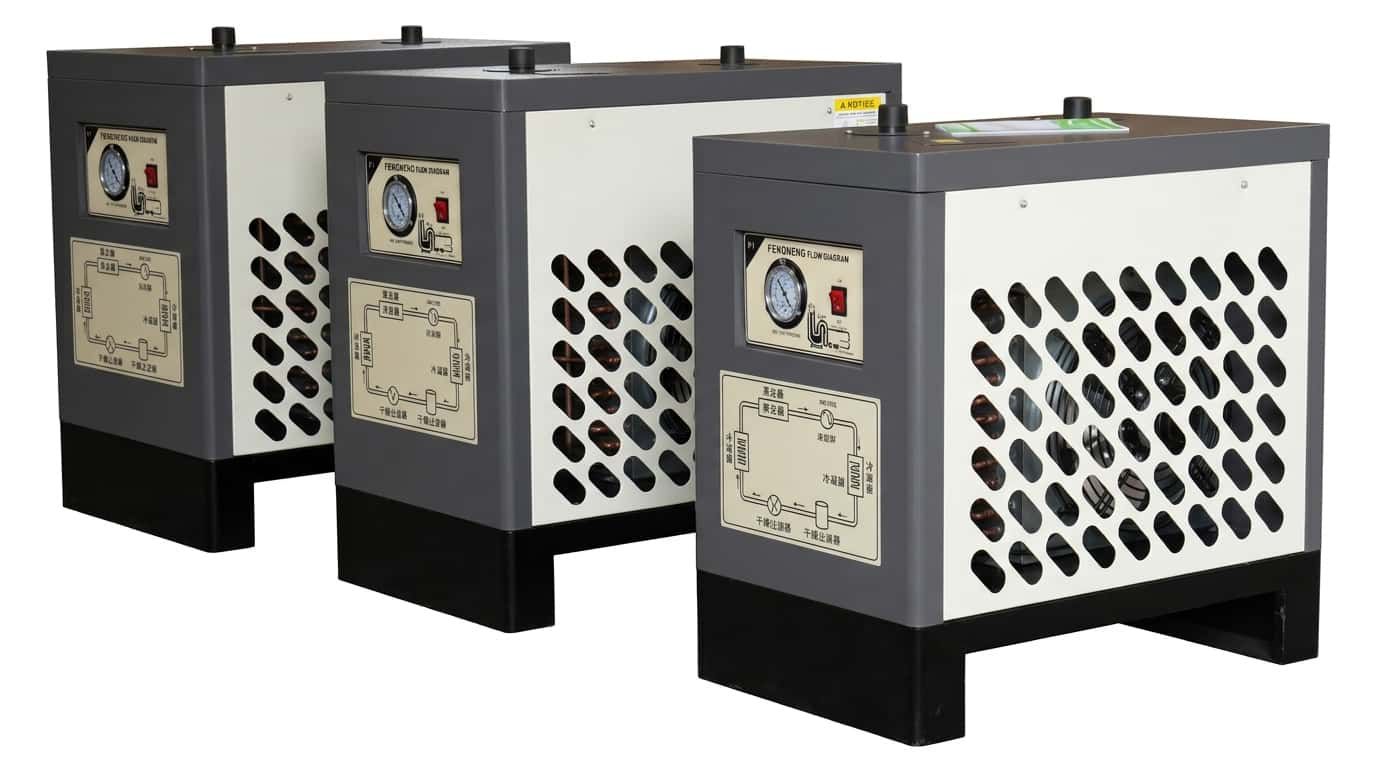
Refrigerated drying is the economic default. Running cost is close to that of the cooling circuit itself, there is no desiccant to regenerate, and the dryer asks almost nothing from the compressed-air system in return. Its limit is physics: it cannot take the dew point below freezing without risking ice inside the heat exchanger.
SIND’s refrigerated dryer range → The ChillDry CD series is sized by compressed-air flow, operating pressure and ambient conditions, and suits general plant air that does not need a desiccant dew point.
How a desiccant air dryer works
A desiccant air dryer takes over where refrigeration stops. The air passes through a vessel packed with desiccant material — typically activated alumina or molecular sieve — which adsorbs water vapour directly from the stream. Twin vessels alternate: one dries the air while the other regenerates, so the output never stops.
The result is deep drying. A desiccant dryer reaches pressure dew points of −40 °C as a standard duty, and −70 °C or lower where the process demands it — Classes 2 and 1 for water under ISO 8573-1. At those levels moisture no longer condenses even in outdoor piping through a cold winter night, and it stops interfering with sensitive processes altogether.
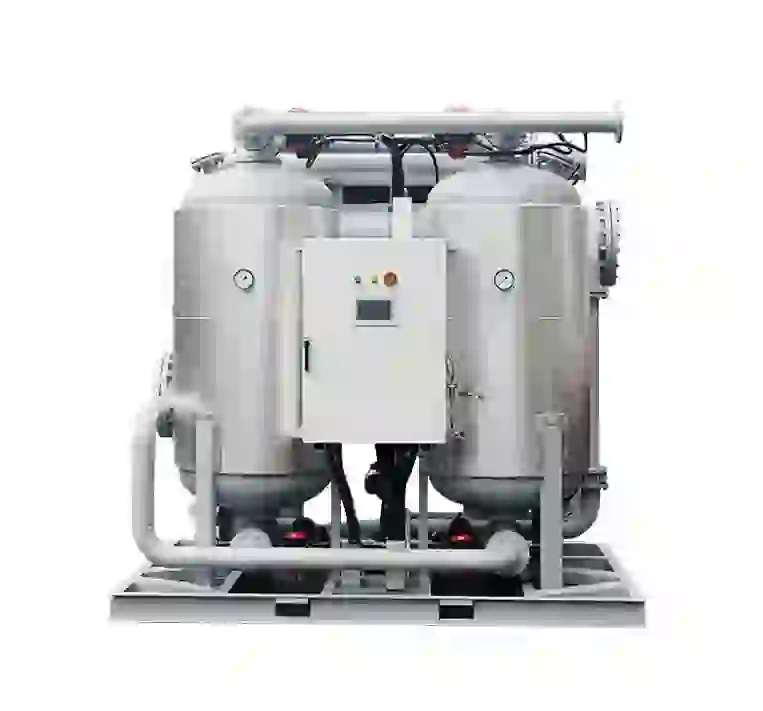
The trade-off is the regeneration of the desiccant. Whether it is done with a purge of dried air, with heater power, or with ambient heat, it consumes energy or air that the compressor has already paid for — which is exactly why a desiccant dryer should only be bought when a refrigerated dryer genuinely cannot do the job.
SIND’s desiccant dryer range → The DryTech DT series covers duties from 1.5 to 150 m³/min with dew points from −40 °C down to −70 °C or lower.
Refrigerated vs desiccant: the key differences
| Refrigerated dryer | Desiccant dryer | |
|---|---|---|
| Achievable pressure dew point | Around +3 °C (ISO 8573-1 Class 4 water) | −40 °C to −70 °C or lower (Class 2 to 1) |
| Working principle | Chills the air; condenses and drains the moisture | Adsorbs vapour onto desiccant; twin towers regenerate |
| Typical energy profile | Refrigeration circuit only | Higher: purge air or heater power for regeneration |
| Downstream effect | Protection against rust and water in general plant air | Dry air in outdoor lines, instruments, coating, food, pharma, electronics |
| Cost logic | Lowest cost per m³ of dry air | Paid only where deep dew point is a real requirement |
Which one should you choose?
The decision comes down to where the air travels and what it touches. Four checks, in order, resolve most cases:
- Where do the pipes run? If any line passes through unheated areas or outdoors where winter temperatures fall below +3 °C, refrigerated air alone will condense again inside those pipes — that pushes you toward desiccant drying, at least for that part of the system.
- What touches the air? Paint and powder coating, food and pharmaceutical contact, electronics, laboratories and precision instruments are typical reasons to specify −40 °C or drier. Ordinary pneumatic tools, cylinders and machine shops rarely need it.
- What does the process cost when it fails? Rejects and rework in a coating line dwarf the price difference between two dryer types. The drier the requirement, the more sense desiccant makes — but only at the flow actually needed.
- Is one plant, one answer? Not necessarily. Many facilities dry the whole distribution system to a modest dew point and treat a single critical branch with desiccant. Splitting the duty this way usually costs less than deep-drying everything.
As a rule of thumb: if the air stays inside a heated plant and feeds general equipment, refrigerated is right. If air goes outdoors, or the product or process cannot tolerate moisture, desiccant enters the picture — often on one branch rather than the whole plant.
Before you specify: the four numbers to confirm
Whichever family you choose, sizing starts with four inputs — the same ones our engineers ask for before quoting a dryer:
- Actual flow from the compressor (FAD, not nameplate), in m³/min or cfm;
- Operating pressure, because dryer ratings change with pressure;
- Ambient conditions at the installation site — temperature, ventilation, cooling medium;
- The dew point the process actually requires, which is where the refrigerated-vs-desiccant decision becomes a number.
Bring those four numbers, and the dryer selection becomes a table lookup rather than a guess. SIND supplies ChillDry CD refrigerated dryers and DryTech DT desiccant dryers as part of complete compressed air systems, and we are glad to review your duty point before you commit to a size.
