

Ask for “a compressor” and you get a machine. Ask for compressed air where it needs to be, dry and clean and reliably, and you need a station. The difference between the two is exactly where many plant projects go wrong — so here is what a complete, integrated compressed air station contains, what “integrated” actually means, and how to tell whether one is the right buy for your plant.
Compressor vs complete air station: the real difference
A compressor raises air pressure. A complete air station turns that raw, hot, wet output into usable plant air. Between the two sits a chain of components that each solve one specific problem — and if any link is missing or badly sized, the weakness shows up downstream as water in pipes, dirty product, or a compressor that cannot hold pressure.
What a complete compressed air station contains
- Compression — the screw compressor itself, with the motor and drive that match the plant’s load profile. In SIND station ranges that means a permanent-magnet variable-frequency drive, so output follows demand instead of cycling between load and unload.
- Aftercooling and moisture separation — hot air leaving a compressor carries water vapor that will condense somewhere; the sooner and more deliberately it condenses, the less reaches your ring.
- Drying — a refrigerated dryer for general plant air (moisture control to roughly 1.7–10 °C pressure dew point) or a desiccant dryer when lines run outdoors or the process needs deep drying down to −40…−70 °C.
- Filtration — particle and coalescing stages sized for the dirt and oil aerosol load, protecting both the dryer and the points of use.
- Storage — a receiver tank that buffers demand peaks, damps compressor cycling, and provides the control reserve that keeps a VFD machine in its efficient band.
- Condensate management — drains and separators that collect everything the dryer and cooler removed, and dispose of it properly.
- Controls — the sequencing brain: VFD control on the machine, plus monitoring so the operator sees pressure, hours, and alarms instead of guessing.
That is what the word “station” should mean when you see it on a quotation: all of the above, selected as one system against one duty point.
What “integrated” adds
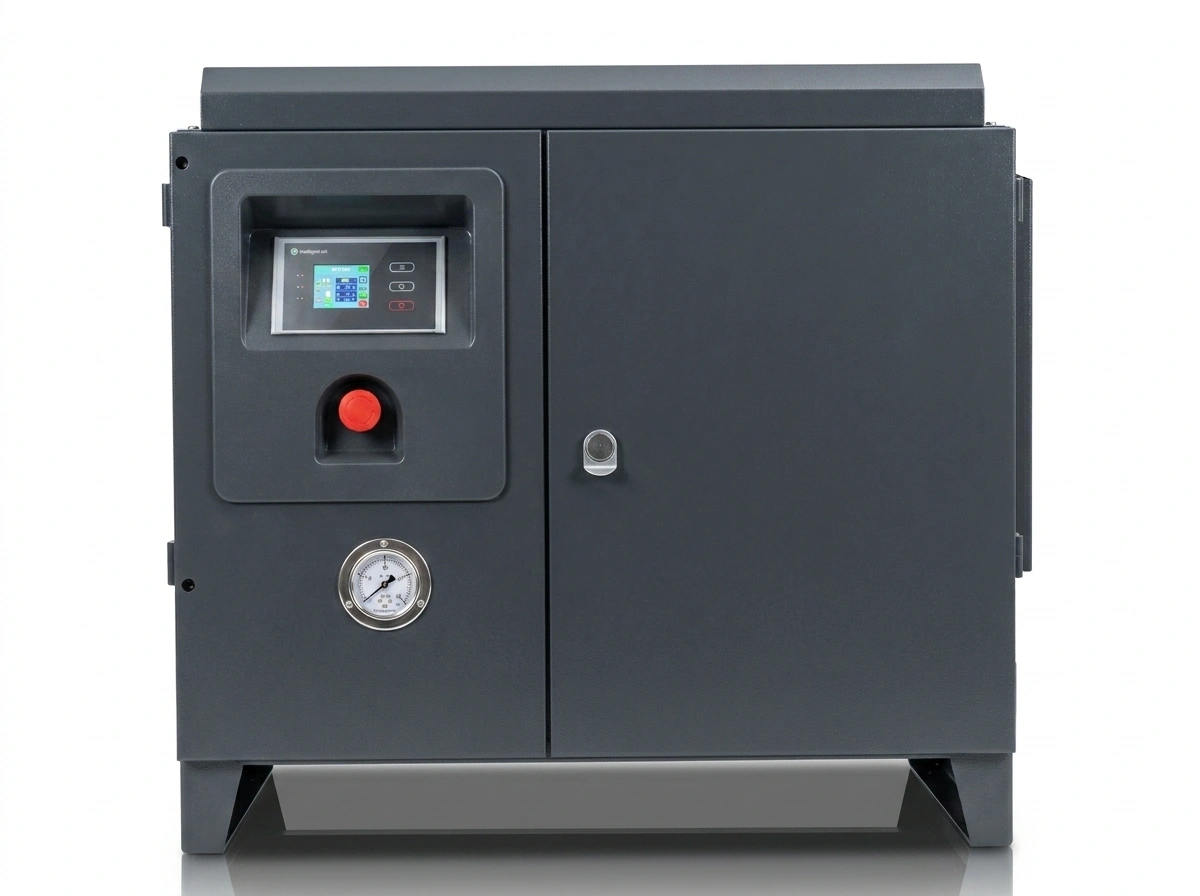
An integrated station packages that chain into one engineered enclosure — compressor, dryer, filtration, and storage mounted and piped at the factory, with controls wired and tested as a unit. You receive one connection point for power and air, one tested system, and a footprint that fits a small compressor room instead of a hall.
SIND ships two enclosure philosophies, and the choice between them is about floor space and height, not quality:
- StationPack SN-H (horizontal) — a low, wide format covering 2.2–30 kW at 220/380 V, with pressure options of 8/10/12.5/14/16 bar and air delivery from 0.30 up to 3.5 m³/min depending on model and pressure. Suited where ceiling height is generous and floor area is available.
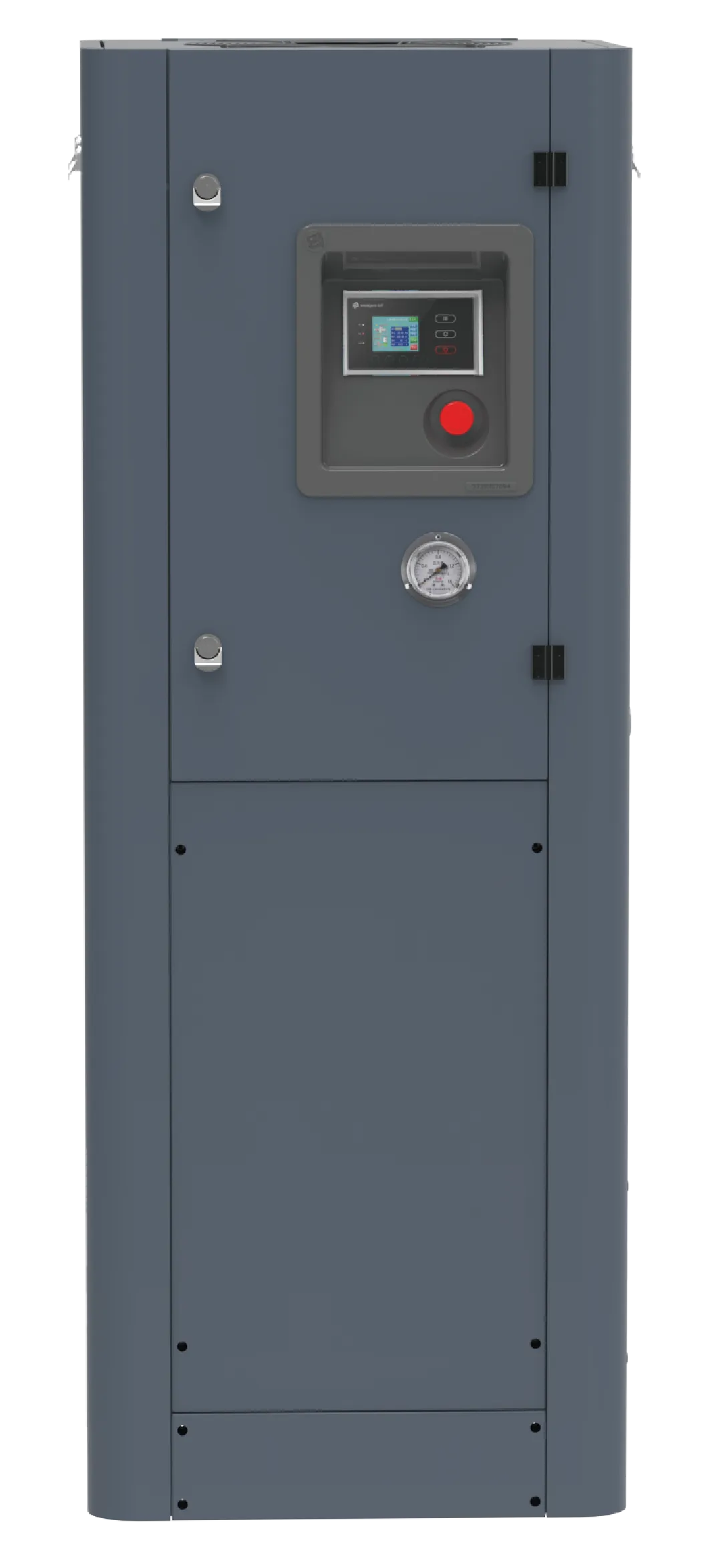
- StationPack SN-V2 (vertical) — a compact tower covering 3.7–30 kW at 220/380 V, from 8 up to 12.5 bar depending on model, in enclosures as small as 690×690×1,750 mm on the smaller frames. Suited where floor space is scarce and a tower can stand in a corner.
For larger or project-specific duties, station classes such as SE-020 and SE-050 are defined by nominal capacity — 20 and 50 m³/min respectively — with the exact scope confirmed in a technical review against site conditions rather than picked from a catalogue row. There is also a dedicated StationPack SE Laser Cutting class for 16–20 bar laser-cutting air, a duty where pressure, dew point and oil aerosols are all unforgiving at once.
The economics: why stations win on lifecycle cost
Buying components separately can look cheaper on a line-by-line quotation. The lifecycle math usually says otherwise:
- One duty point, one design. When the compressor, dryer, filters, and tank are selected together, each is sized for the same flow, pressure, and ambient reality — no undersized filter quietly throttling a new compressor, no dryer swamped by aftercooling that never happened.
- VFD where it pays. Load/unload cycling wastes energy in every plant with a swinging demand profile; a permanent-magnet VFD following the load avoids most of it.
- Installation that cannot be mis-piped. Factory piping and wiring remove the classic site errors — reversed flow arrows, undrained intercoolers, controller cables crossing power cables.
- One service interface. One vendor, one warranty conversation, one set of service intervals across the whole station.
When an integrated station is (and is not) the right buy
Good fit: small to mid-size plants that need reliable air without dedicating engineering time to component matching; workshops where floor space is tight enough that the vertical format pays for itself; operations that want one responsible partner instead of a board of component vendors; projects where the machine room is also the shop floor and noise, footprint, and tidiness matter.
Not a fit: large plants whose demand is spread across several buildings and better served by a central house plus ring main; sites with existing healthy components that only need one gap filled; project classes where scope genuinely needs engineering definition first — that is what the SE review process is for, not a limitation to hide.
How to brief a station supplier
Whatever brand you approach, the quality of the quote depends on the quality of the brief. Five lines cover it:
- Air demand in m³/min (FAD) at the working pressure, and which consumers set the peak.
- Required air quality — general plant air or process-critical — and any outdoor or high-temperature piping runs.
- Electrical supply available at the installation point (voltage and capacity).
- The space itself: floor area, ceiling height, ambient temperature, and noise limits.
- Load profile: shift pattern, peaks, expected growth.
With those five lines, “complete air station” stops being a slogan and becomes a system you can hold the supplier to.
